
Since its founding Israel has relentlessly pursued peace with its Arab neighbours, sacrificing both lives and land to achieve this goal.
Land for peace
Israel has traded 90% of the territory it captured in defensive wars for peace with its neighbours. There are few states in history that have voluntarily given up so much territory (the land Israel has given away is equivalent in size to three Israels).
- 1974 – Israel hands a third of the Golan Heights over to the UN.
- 1979 – Israel gives the Sinai Peninsula to Egypt. At 60,000 km sq this area is three times the size of Israel.
- 1982 – Israel returns Tiran Island to Egypt.
- 1995 – Israel begins withdrawing from the West Bank ultimately giving away 18% of the territory (Area A), it also bans its citizens from accessing a further 38% (Area B and most of Area C)
- 2000 – Israel withdraws from Southern Lebanon, giving up 1,000 km sq of land.
- 2005 – Israel completely withdraws from the Gaza Strip and a number of settlements in the West Bank (Kadim, Ganim, Homesh, and Sa-Nur).
Israeli peace proposals
- 1949 – Armistice agreements
- Israel agrees to an Egyptian occupation of Gaza
- Israel returns 13 Lebanese villages it had captured back to Lebanon
- Israel agrees to a Jordanian occupation of East Jerusalem and the West Bank
- Israel swapped control of Wadi Ara and the Little Triangle in exchange for territory in the southern hills of Hebron.
- 1967 – Allon Plan
Israel offers approximately 65% of the West Bank territory it had captured from Jordan in the Six Day war back to the Jordanian, leaving it to the Jordanians to decide whether or annex or make a Palestinian state. The offer was rejected. - 1978/9 – Camp David Accords and the Israel-Egypt Peace Treaty
- Israel returns the Sinai Peninsula to Egypt, an oil rich territory three times the size of Israel.
- Egypt becomes the first Arab state to recognise Israel’s right to exist
- Israel and Egypt sign a peace treaty
- Israel offers to withdraw from the West Bank and Gaza so that Palestinians can self-rule in the disputed territories, an offer which the Palestinians rejected.
- The Egyptian President is labelled a traitor by the other Arab states and he is eventually assassinated.
- 1993-5 – Oslo Accords
- Israel recognises the PLO as the representative of the Palestinians
- Israel handed over governance of the West Bank and Gaza Strip to the Palestinian Authority
- Israel agreed to completely withdraw from parts of the Gaza Strip and 3% of the West Bank
- Israel agreed to remove and ban its citizens from a further 25% of the West Bank.
- The PLO recognised Israel’s right to exist
- 2000/1 – Camp David and Taba Summits
- Israel offered Palestinians virtually everything they had been demanding, including a sovereign state
- Israel agreed to Jerusalem being the capital of this state
- Israel agreed to handing over control of the holiest Jewish site, the Temple Mount, to the Palestinians
- Israel agreed that the Palestinian state would consist of approximately 95 percent of the West Bank and all of the Gaza Strip
- Despite blaming the Arabs for the Palestinian refugee problem, Israel offered $30 billion in compensation to the 1948 Palestinian refugees.
- The Palestinians rejected this and launched the second intifada.
- 2005 – Gaza disengagement
- Israel completely withdraws from the Gaza Strip leaving it under the government of the Palestinian Authority.
- Israel disengages from a number of settlements in the north of the West Bank
- 2010/11 – Israel-Palestinian peace talks
Israel offers to stop building settlements for 10 months in all areas of the West Bank except Jerusalem. The Palestinians refused to enter talks.
Israeli Attitudes Towards Two-State Solution
The majority of Israelis have consistently supported a two state solution, while opposition has rarely risen over a third.
- 2015 – In March 62% of Israelis said they supported a two state solution x
- 2014 – In December 59% of Israelis said they supported a two state solution y
- 2014 – In July 60% of Israelis said they supported a two state solution z
Humanitarian assistance to Palestinians
Medical assistance
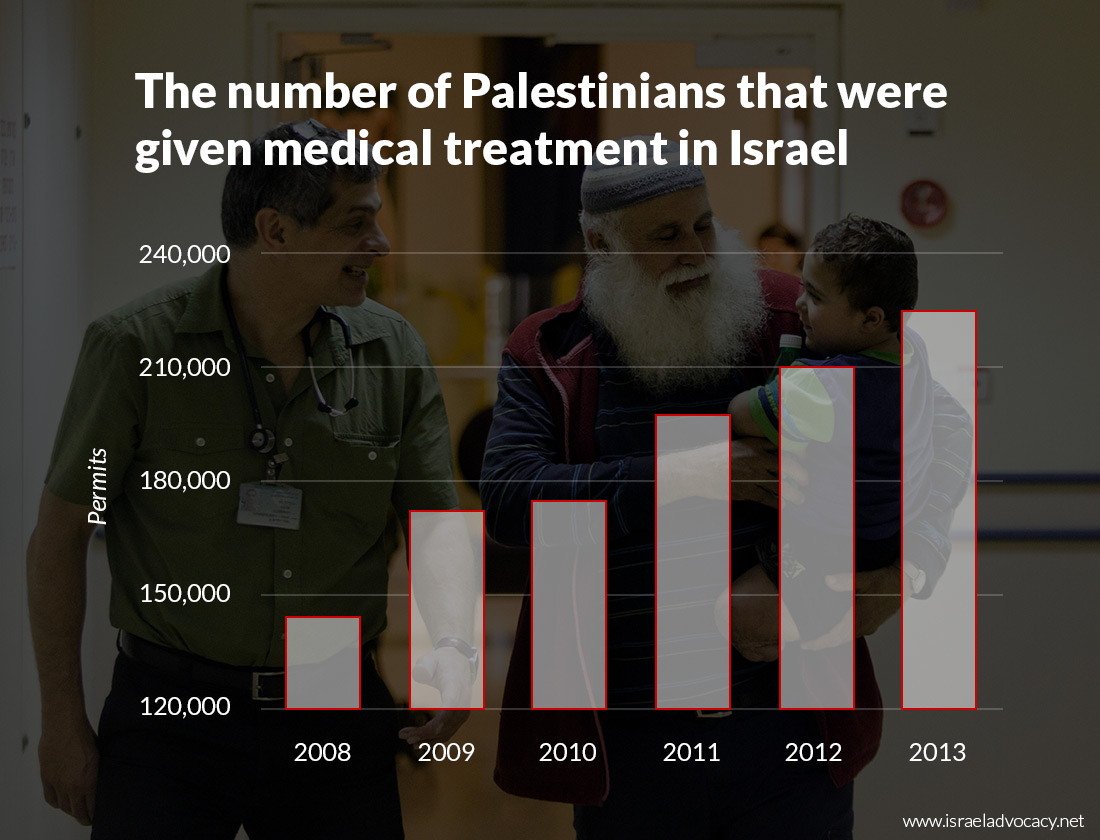
Hundreds of thousands of Palestinians are treated in Israel every year, few democratic states provide so much medical assistance to the civilian populations of nations that they are in conflict with.
Electricity and water
Israel provides the West Bank and Gaza with electricity and water. Palestinians receive these services at a much cheaper rate than Israelis. Despite the reduced rate the Palestinian Authority is in a state of permanent debt for the services as it rarely pays its bill. Despite owing the Israel Electric Corporation over 662 million shekels, Israel continues to provide electricity to the PA. This includes supplying electricity to government buildings such as schools, hospitals, and water pumping stations.
Employment
Israel employs around 100,000 Palestinians to work in the Israeli economy sphere. By March 2014, about 45,000 permits was issued for work in Israel with further 25,000 issued for work in West Bank settlements. It is estimated 35,000 Palestinian work through illegal channels and without a permit.
Recognising A Palestinian State
- Shimon Peres
“We are in favor of the creation of a Palestinian state and maintaining Israel as a Jewish, Democratic state – the debate is about how to reach that goal of a Palestinian state … we think that in order to have a democratic and Jewish state, we need a Palestinian state as well” a - Benjamin Netanyahu
“I stood before my people and I said I will accept a Palestinian state” e - Ehud Barak
In 1993 during the Oslo Accords Barak offered the Palestinians a state with its capital in Jerusalem, composed of approximately 95 percent of the West Bank and all of the Gaza Strip. c - Ariel Sharon
“It is up to the Palestinians to govern themselves in their own state” b - Ehud Olmert
“We support the establishment of a modern, democratic Palestinian state which respects civil rights, and is economically prosperous. Their welfare is our welfare, their well-being is our well-being, their stability is our stability.” d
Do the Palestinians want peace?
While Israel has made numerous attempts at peace, the Palestinians have rejected each opportunity to establish an independent state.
- 1937: Rejected a state 1,697% larger than the pre-67 borders
- 1947: Rejected a state 83% larger than the pre-67 borders
- 2000: Rejected one 3% smaller than the pre-67 borders
- 2008: Rejected one the same size than the pre-67 borders
Sources
a. Shimon Peres, in a meeting with French Prime Minister, reported in the Jerusalem Post, “Peres to Hollande: Palestinian state needed for democratic, Jewish state”, 18/12/2014
b. Ariel Sharon, in a meeting with American President George W Bush and Palestinian Leader, Mahmoud Abbas, reported in The Guardian, “Sharon endorses Palestinian state”, 4/6/2003
c. “The Case for Peace”, Alan Deshowitz, p9
d. Ehud Olmert, 6th Herzliya Conference, 24/1/2006.
e. Benjamin Netanyahu, U.S. Congress, 24/5/2011
x. The Peace Index: March 2015,
y. Joint Israeli Palestinian Poll – 54, Harry S. Truman Research Institute for the Advancement of Peace at the Hebrew University of Jerusalem and the Palestinian Center for Policy and Survey Research in Ramallah , 7-12 December 2014
z. Dialog Institute under the supervision of Prof. Camil Fuchs of Tel Aviv University, July 2014
https://www.standwithus.com/news/article.asp?id=1694